
Gambling should use only money and time set aside for entertainment. It is not a reliable way to earn income, repay debt or recover previous losses. Every casino game has a mathematical house advantage, and short winning periods do not remove the possibility of losing the full amount staked.
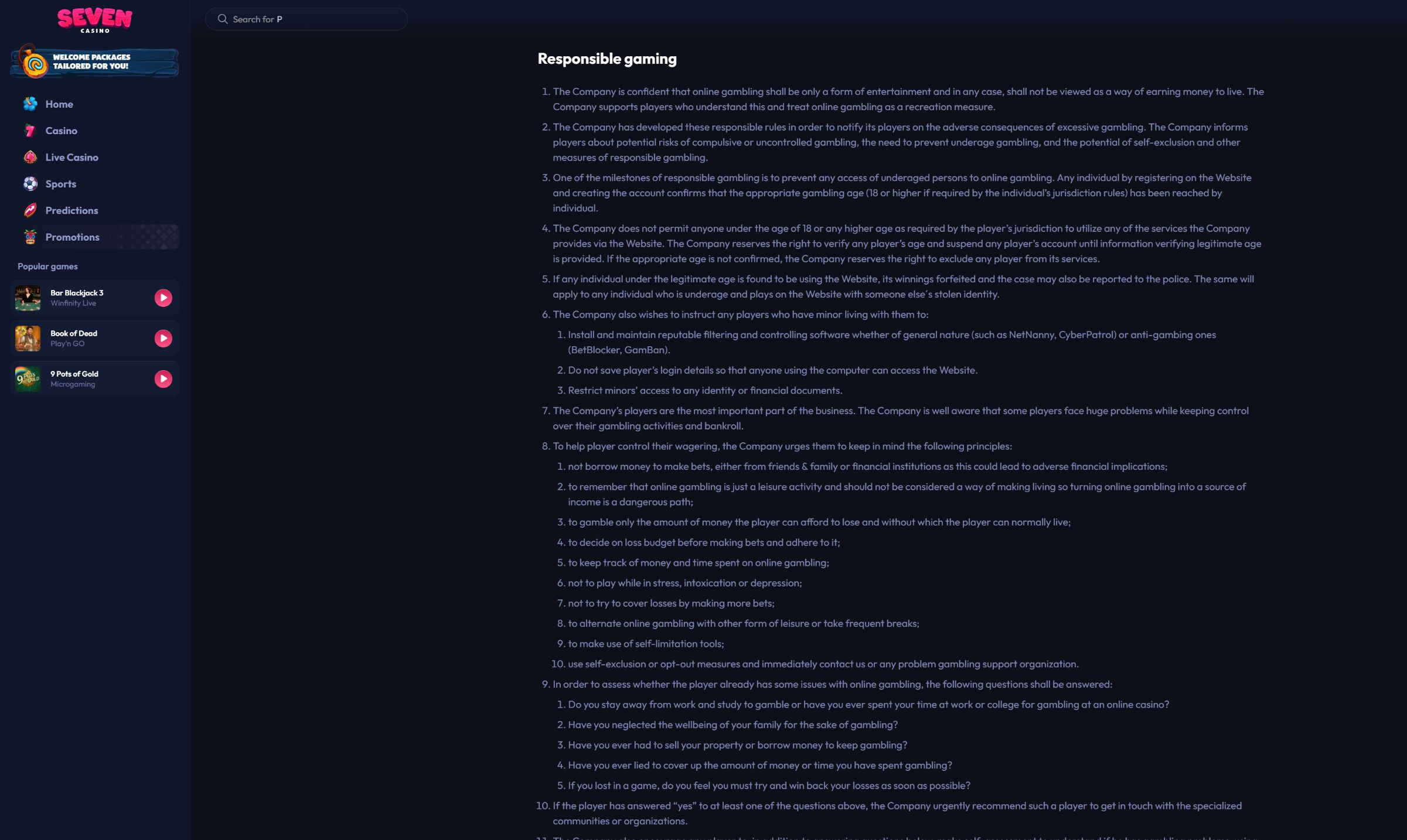
Seven Casino’s responsible-gaming material identifies breaks, limits and self-exclusion as account controls. A control works best when it is applied before gambling becomes difficult to stop. Anyone already chasing losses, borrowing to play, hiding transactions or missing essential payments should stop depositing and seek independent help rather than trying to regain control through another bet.
Immediate steps when gambling feels unsafe
| Situation | Action to take now |
|---|---|
| Strong urge to chase a loss | Sign out, leave the device and make no further deposit |
| Essential money has been used | Stop play and contact a free debt or gambling-support service |
| Repeated return after planned stopping time | Request a break or self-exclusion and use device/payment blocks |
| Account access is being used impulsively | Change access conditions with help from a trusted person without sharing the password |
| Thoughts of self-harm or immediate danger | Contact local emergency services or a crisis service immediately |
If there is immediate danger, casino support is not an emergency or mental-health service. Contact the emergency number where the person is physically located. Do not leave a person at immediate risk alone while help is being arranged.
Warning signs of gambling harm
One sign does not establish a diagnosis, but a repeated pattern deserves action:
- spending more money or time than planned;
- increasing stakes to recreate an earlier level of excitement;
- chasing losses with another deposit;
- borrowing, using credit or selling possessions to gamble;
- hiding play or transactions from family;
- feeling restless, anxious or irritable when trying to stop;
- gambling during work, sleep or family time;
- treating a bonus as income or a way to repair debt;
- cancelling withdrawals to continue playing;
- opening new accounts after closing or excluding from another service;
- continuing despite financial, health or relationship harm.
The useful question is not whether someone fits a label. It is whether gambling is causing harm or becoming harder to control. Controls and support are appropriate before a crisis develops.
Set a real entertainment budget
A gambling budget comes after rent, food, utilities, debt payments, savings and other essential commitments. It should be an amount that can be lost in full without changing any of those obligations.
| Control | Weak version | Protective version |
|---|---|---|
| Money limit | “I will try not to spend much” | Fixed weekly amount that cannot be topped up |
| Time limit | “I will stop when I feel done” | Alarm and fixed end time before login |
| Loss response | Increasing stakes to recover | Session ends when the loss limit is reached |
| Win response | Replaying the complete balance | Withdraw a pre-set amount and end the session |
| Payment access | Every card and wallet available | Gambling transactions blocked or limited where possible |
| Record keeping | Looking only at current balance | Reviewing total deposits and withdrawals over time |
Bonus money should not expand the cash budget. A matched deposit increases required play and exposure to variance; it does not reduce the amount of real money at risk. The maximum promotional amount is never a recommended deposit.
Breaks and limits
A short break prevents account access for a defined period and can interrupt an escalating session. Longer limits should address both money and time: deposit, loss, wager and session controls are not interchangeable.
A deposit limit controls money entering the account but may not prevent a large existing balance from being wagered. A loss limit focuses on net loss during a period. A wager limit restricts total turnover, which can be much higher than net loss. A session reminder shows elapsed time but still requires the player to act.
Where a setting offers immediate increases but delayed decreases, choose the stricter value in advance. If the official account interface does not provide the required control, contact [email protected] and ask for it in writing.
Seven Casino self-exclusion
Seven Casino directs customers to request self-exclusion through [email protected]. The request should clearly say “self-exclusion,” state the desired period and ask for written confirmation. Standard account closure is not an equivalent substitute because the Terms describe possible reactivation after a 30-day closure.
The operator’s policy says self-exclusion cannot be shortened or cancelled before the chosen period ends. It also states that the account cannot be accessed and withdrawals cannot be made during the exclusion, while open bets remain and settle. Before activation, ask support to confirm how an existing withdrawable balance and pending request will be handled.
A clear request can read:
Please self-exclude my Seven Casino account immediately for [period]. I understand that the exclusion cannot be reversed early. Please confirm the status of my remaining balance and any pending withdrawal without offering promotions or reopening options.
Save the email, delivery record and response. Remove marketing permissions and ask the operator to suppress promotional messages. If contact or access continues after confirmation, record the dates and escalate in writing.
Layer account controls with external barriers
Self-exclusion from one website does not block every gambling service. Strong protection uses several independent barriers:
- Exclude from each gambling account used.
- Install reputable gambling-blocking software on every device.
- Ask the bank or payment provider to block gambling transactions where available.
- Remove saved cards, wallets and autofill payment data.
- Unsubscribe from promotional email, SMS, push notifications and social channels.
- Tell a trusted person and agree on a check-in plan.
- Obtain professional support for gambling harm and any connected debt or mental-health issue.
No single barrier is perfect. The purpose of layering is to turn an impulsive decision into a sequence with enough delay to seek help.
Independent support
Independent services do not manage Seven Casino accounts, but they can provide confidential advice, recovery tools and local referrals.
| Service | Support available | Official access |
|---|---|---|
| Gambling Therapy | Global text-based live support, groups and forums; multilingual support using translation | gamblingtherapy.org |
| Gamblers Anonymous | Peer meetings and fellowship resources in multiple locations | gamblersanonymous.org |
| GamCare | Free confidential helpline, chat, WhatsApp and treatment referral; 24/7 service for people within its service area | gamcare.org.uk |
| Befrienders Worldwide | Directory of emotional-support centres by country | befrienders.org |
Gambling Therapy is particularly useful for international access because its live text service supports multiple languages and can help locate local resources. Family members and friends can seek support even when the person gambling is not ready to do so.
Support details were checked against the organisations’ official websites on 5 September 2026. Service hours and coverage can change, so use the linked official page rather than an old copied phone number.
Help for family and friends
Do not lend money to fund further gambling or pay a gambling debt on the condition that the person will win it back. Protect shared finances first: separate essential funds, change shared-account permissions where lawful, review credit exposure and obtain independent financial advice.
Choose a calm moment to discuss specific observations rather than arguing about labels. “Three rent payments were transferred to gambling sites” is harder to dismiss than “you always gamble too much.” Offer to sit with the person while they contact a support service or request self-exclusion.
Family members should not impersonate the account holder, guess passwords or submit false account instructions. They can contact support to report a welfare concern, but privacy rules may prevent the operator from disclosing account information without authorisation.
Safer handling of a remaining balance
When someone decides to stop, a pending withdrawal should normally remain outside the playable balance. Cancelling it to make one final bet recreates the immediate risk. Complete any legitimate identity check promptly, keep transaction evidence and ask support to explain delays in writing.
If self-exclusion would block access before the withdrawal is resolved, obtain written instructions on balance handling first while making no further wager. The request can ask the operator to lock gambling immediately while preserving administrative communication about KYC and payment.
Responsible gambling FAQ
Is self-exclusion the same as closing a Seven Casino account?
No. Standard closure is described as potentially reversible after 30 days. Self-exclusion is a protective measure that the operator says cannot be shortened or cancelled before the selected period ends.
Can money be withdrawn during Seven Casino self-exclusion?
The operator’s policy says account access and withdrawals are unavailable during exclusion. Ask for written balance and pending-payment arrangements before activation while requesting that gambling be disabled immediately.
Do open bets disappear after self-exclusion?
Seven Casino says open bets remain and settle. Request confirmation of how any resulting balance will be paid without restoring gambling access.
Can a family member self-exclude someone else?
Usually the account holder must make the formal request. A relative can report a welfare concern and seek advice, but the operator may be unable to disclose or change account data without proper authority.
Are deposit limits enough to control gambling?
Not always. They do not necessarily restrict an existing balance, time spent or access to other sites. Combining account limits, payment blocks, device blocking and support creates stronger protection.
What should happen to casino marketing after self-exclusion?
Ask for promotional email, SMS, push notifications and personalised offers to stop. Record any marketing received after confirmation and report it to the operator.
Where can someone get help in another language?
Gambling Therapy provides global text-based support and uses automated translation, with native-language support for several languages. Its advisers can also help identify local services.
Is gambling a way to repay debt?
No. Every wager risks increasing the debt, and chasing losses commonly escalates harm. Stop depositing and use independent gambling-support and debt-advice services.
Last reviewed: 5 September 2026 Emergency note: If anyone is in immediate danger or may harm themselves, contact local emergency services now. Independence: This website is not Seven Casino and cannot activate limits, exclude an account or release a withdrawal.